
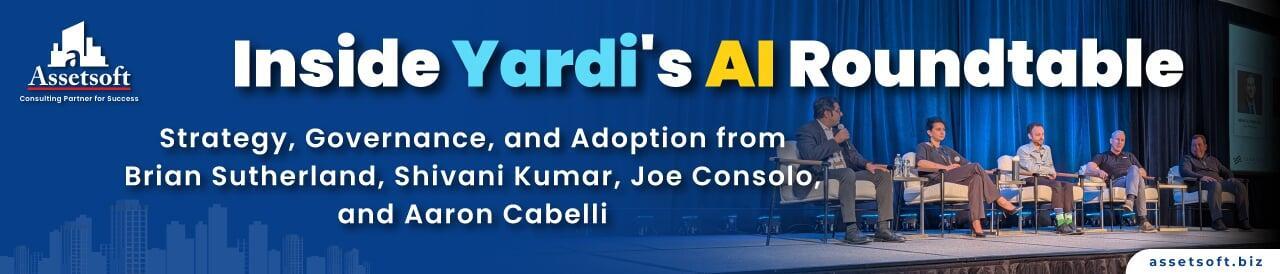
Strategy, Governance, and Adoption from Brian Sutherland, Shivani Kumar, Joe Consolo, and Aaron Cabelli
Year 2
of a 5-year AI journey, per Shivani Kumar's framing
at the briefing
3 client tiers
from just-getting-started, to actively researching, to actively deploying agents
78%
of Virtuoso Support queries resolved without escalation across hundreds of clients
The numbers above frame how Yardi positions its AI program: a multi-year build, a market segmented by readiness, and a deployed product line that already serves hundreds of property management firms. The AI Roundtable session at the May 2026 Yardi Executive Briefing brought together the four people responsible for translating that program into client outcomes.
This post synthesizes the Roundtable's core themes, AI strategy, governance, and adoption and grounds them in each panelist's published Yardi positions. Where direct framings come from the briefing's panel sessions, those are noted. Where statements come from Yardi's published announcements, those are linked. The intent is to give real estate firms evaluating Yardi's AI program a clear read on the platform's direction without speculation.
The four people setting Yardi's AI direction
The Roundtable was titled "AI Roundtable: Meet the Yardi Virtuoso Team", a deliberate framing for a session situated within an Executive Briefing oriented toward consulting partners. The format brought the four people responsible for shaping and shipping Virtuoso into one conversation, making visible how the program operates: who owns what, what is shipping, what is gated, and where partner work is most valuable.
Panelist | Yardi role | Topical focus at the briefing |
Brian Sutherland | Vice President, Commercial | Yardi's overall AI strategy direction, agent-based architecture, and the 'AI Org Chart' concept were publicly co-introduced with Yardi president Akshai Rao in February 2026 |
Shivani Kumar | Industry Principal | Client AI strategy engagement; the gap between AI excitement, resource allocation, and execution; the 5-year industry journey framing |
Joe Consolo | Industry Principal | Client adoption patterns; three tiers of buyer readiness; the security and permissions moat versus third-party AI vendors |
Aaron Cabelli | Senior Product Manager | Virtuoso product roadmap; month-end close as the highest-leverage anchor agent; when agents replace stored procedures |
Each panelist sits at a different intersection of the program. Sutherland anchors strategic direction. Kumar runs client AI strategy engagements weekly. Consolo carries client adoption patterns from across the field. Cabelli builds and ships the actual product. The Roundtable made these intersections visible.
Strategy: Agents, the 'AI Org Chart,' and the Composer-Marketplace pattern
Yardi's strategic AI direction was publicly refined in February 2026 through a Yardi blog post co-authored by Brian Sutherland and Yardi president Akshai Rao. The published strategy turns on three architectural decisions:
• AI is delivered through agents' specific tasks delegated to specialized AI workers, each configured to be an expert in its respective area, rather than a single monolithic AI assistant.
• Real estate organizations are encouraged to think in terms of an 'AI Org Chart, ' the structured map of which agents will perform which functions, and how those agents will connect into upstream and downstream systems.
• Agent creation and distribution operate through Virtuoso Composer (the no-code builder) and Virtuoso Marketplace (the agent distribution layer at virtuoso.ai), where Yardi, third-party consultants, and clients can all create and consume agents.
This strategic framing answers a central question for consulting partners working with Yardi clients: where does partner work fit? The published answer is that direct partners build agents in Composer, distribute through the Marketplace, and wrap implementation services around the agent lifecycle. Per Yardi's published strategy update, partners are not auxiliary to the program; they are constituent to it.
Governance: why the Yardi-internal model is structurally different from third-party AI
Governance was the highest-stakes topic in the panel sessions. Joe Consolo framed the architectural argument throughout the briefing: the dominant client concern about external AI vendors is not capability but access control.
The third-party data extraction problem
Most AI vendors targeting Yardi-running organizations operate by ingesting Voyager exports into their own environment. That model breaks the Yardi security architecture. Property-level restrictions, role-based permissions, and tenant data segregation, all defined in Voyager, are absent from a flattened export. As Consolo emphasized in the Virtuoso panel session, the number-one client concern with third-party AI tools is team members circumventing security controls to access data they normally cannot access.
The Yardi-internal architectural commitment
Yardi's published Virtuoso architecture preserves the security model end-to-end. User permissions and credentials carry through into the AI interaction. A user who lacks visibility into a specific property in Voyager will not see that property's data in Virtuoso Support, agent-driven workflows, or Connectors. Yardi's Virtuoso platform documentation makes this a structural property of the platform rather than a configuration option.
What this means for compliance and audit conversations
In jurisdictions where data privacy and access governance are regulated, such as Canada (PIPEDA), the European Union (GDPR), Australia (Privacy Act), the United Arab Emirates (data residency), and the United States (state-level frameworks), a third-party AI deployment that exports Voyager data introduces a new regulated data flow. The Virtuoso-internal model does not. For CISO and compliance officer conversations, this is a meaningful architectural difference, not a marketing distinction.
Adoption: the three tiers of client readiness
Joe Consolo's adoption framework, presented across the briefing's panel sessions, divides the Yardi client base into three tiers based on AI readiness:
Tier 1 - Just getting started
These clients are still figuring out where to apply AI. They have not yet selected a vendor or initiated an internal AI program. Conversations focus on strategy, framework selection, and the identification of the first one or two use cases worth resourcing. This is the largest tier by client count.
Tier 2 - Actively researching solutions
These clients are evaluating vendors. Per Consolo's framing, the first vendor consideration is often not Yardi; it is a third-party AI specialist that has approached them directly. The second or third vendor evaluated is typically Yardi. Consolo noted that this group is consistently surprised by the depth of Yardi's roadmap once they engage with it.
Tier 3 - Actively deploying
The minority tier. These clients have already begun building agents. Many have hired internal AI personnel. They are looking less for direction and more for execution velocity. Yardi's positioning for this tier is operational: integrate with what they have already built, accelerate where they are blocked, and provide the agent-deployment infrastructure that lets them scale.
The strategic implication for sequencing
Shivani Kumar's framing across the briefing made the resource-allocation reality explicit: AI excitement is high; resource allocation is materially lower; execution is lower still. Kumar reported working with five to seven clients weekly as Industry Principal, with the engagement scope revisited every couple of months. Most engagements involve scoping the first two or three use cases worth committing to, not building an enterprise-wide AI roadmap on day one. The pragmatic path for most operators starts narrow and compounds over time.
What is shipping? What is gated
The briefing's combined sessions, including the Roundtable, made the program's pacing explicit. Yardi is managing rollout deliberately to maintain stability.
Generally available today
• Virtuoso Support — in Voyager 8 and RentCafe CRM IQ; live with hundreds of clients and tens of thousands of users
• Virtuoso Connectors — starting with Anthropic's Claude as the first LLM partner
• Native AI capabilities embedded in Yardi products, including Maintenance IQ, Smart Lease (AI lease abstraction), and PayScan (AI-powered OCR)
Active beta with selective access
Virtuoso AI Agents and the Virtuoso Marketplace - launched at YASC in September 2025, with active deployment across early-adopter clients. Per Consolo's framing during the briefing, the broader rollout is being staged with a Q3 broader availability target. The throttle is intentional: ensuring stability and operational quality before broader exposure.
Roadmap and emerging
• Composer's continued expansion to allow agent triggers connected to specific Voyager actions referenced in the panel as in-progress, not yet generally available
• Additional Virtuoso Connectors beyond Anthropic's Claude as the LLM partner network expands
• Continued expansion of Virtuoso Support across additional Yardi applications beyond Voyager 8 and CRM IQ
What this means for real estate firms now
The combined message across the briefing's panel sessions, distilled across the four panelists' contributions and Yardi's published strategy, points to four practical conclusions for property management organizations evaluating where to apply AI:
• AI is platform infrastructure, not a feature. Yardi's positioning treats AI as a structural layer of the property management stack, parallel to accounting and reporting, with multi-year investment behind it. Operators building short-horizon AI strategies will find themselves out of step with the platform's direction.
• Governance is an architectural choice, not a procurement choice. The decision to use Yardi-native AI versus a third-party AI vendor is not a price comparison. It is a decision about whether the security model of the system of record carries through into AI workflows. For regulated jurisdictions, this is the controlling decision.
• Sequencing matters more than ambition. The pragmatic adoption path is narrow, compounding, and revisited quarterly. Per Kumar's framing, most operators benefit from picking two or three use cases, building Composer-driven agents around them, measuring outcomes, and expanding from there rather than committing to an enterprise-wide AI roadmap before any agent is in production.
• Partner work is a constituent of the program. Per Sutherland and Rao's published strategy, third-party consultants build agents in Composer and distribute them through the Marketplace alongside Yardi-built agents. Implementation partners are not adjacent to the AI program; they are participants in it.
Where Assetsoft delivers in Yardi's AI program
Assetsoft works across all three tiers of the adoption framework. For Tier 1 clients, Assetsoft scopes initial Virtuoso readiness assessments and builds the AI Org Chart that maps client-specific workflows to Yardi's agent architecture. For Tier 2 clients in active evaluation, Assetsoft delivers a comparative analysis of Virtuoso-native and third-party AI options, anchored in the security and governance differences. For Tier 3 clients deploying agents, Assetsoft builds Composer-based custom agents, integrates Yardi agents with mixed ERP estates through KriyaGo (an integration platform with 100-plus pre-built connectors across MRI, Procore, ViewPoint, CMiC, SAP Concur, and Zoho), and operates the long-tail support that production agent deployments require. Delivery teams across Canada, India, Sri Lanka, and the United States serve clients across North America, Australia, the United Kingdom, the Middle East, and APAC.
Frequently asked questions
Who sat on the Yardi AI Roundtable in May 2026?
The Roundtable, formally titled "AI Roundtable: Meet the Yardi Virtuoso Team," was held during the Yardi Executive Briefing in Santa Barbara during the week of May 4, 2026. The four panelists were Brian Sutherland (Vice President, Commercial), Shivani Kumar (Industry Principal), Joe Consolo (Industry Principal), and Aaron Cabelli (Senior Product Manager).
What is the 'AI Org Chart' concept?
Per Yardi's February 2026 published AI strategy update, co-authored by Brian Sutherland and Yardi president Akshai Rao, the AI Org Chart is a structured map of which AI agents perform which functions within a real estate organization and how those agents connect to other systems. It is the planning artifact for organizations adopting agent-based AI architectures rather than monolithic AI assistants.
How does Yardi's security model differ from third-party AI vendors targeting Yardi data?
Most third-party AI vendors operate by ingesting Voyager exports into their own environments, thereby removing Voyager's property-level and role-based access controls. Yardi's Virtuoso platform preserves those controls end-to-end: user permissions and credentials carry through into the AI interaction. A user who cannot see a property in Voyager cannot access that property's data through Virtuoso. This is a structural property of the platform, not a configuration setting.
What are the three client tiers Joe Consolo described?
Per Consolo's framing across the briefing, Yardi's client base divides into three AI readiness tiers: clients just getting started (figuring out where to apply AI), clients actively researching solutions (often after engaging non-Yardi vendors first), and clients actively deploying agents (the minority tier, often with internal AI personnel). The tier structure determines how a consulting engagement should be scoped.
What is Yardi's published timeline for the broader availability of Virtuoso AI Agent?
Per the briefing, the broader rollout of agent-based capabilities is being staged, with a Q3 broader availability target. Yardi product leadership is managing the pace deliberately to maintain stability. Clients interested in early access should engage their Yardi account team to confirm current eligibility and timing.
How does this Roundtable connect to the rest of the Yardi AI Strategy series?
This is cluster post #3 of a four-part series from the May 2026 Yardi Executive Briefing. The companion posts cover Yardi's data architecture (Data Connect, Replicate, YDMS), the Virtuoso five-layer platform stack with Aaron Cabelli and Joe Consolo, and the pillar post that introduces the ABC framework underlying the full series.
Ready to scope your Yardi AI program?
Assetsoft delivers Virtuoso readiness assessments, AI Org Chart design, Composer-based custom agent development, Virtuoso Marketplace integration, and Connector architecture for property management firms across North America, Australia, the United Kingdom, the Middle East, and APAC. Engagements scope to the client tier and AI readiness.
→ Start with a Virtuoso readiness assessment atwww.assetsoft.biz
