
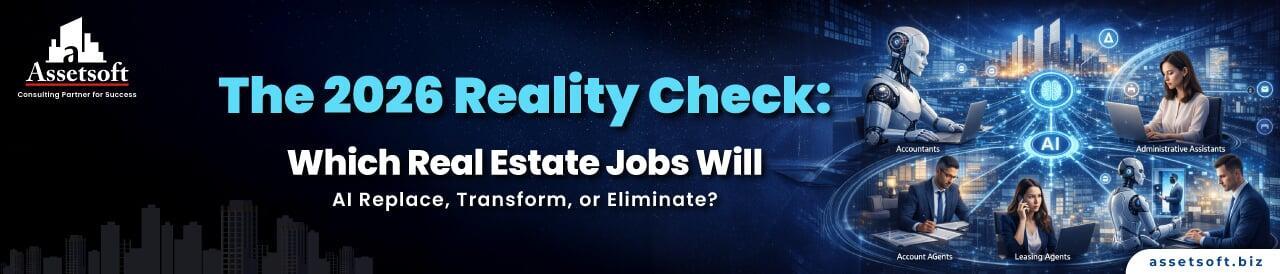
Let's skip the sugar-coating. The World Economic Forum projects that 92 million jobs will be displaced globally by 2030, with the most dramatic shifts occurring through 2026. For real estate professionals, REITs, and property management companies, understanding which roles are at risk isn't optional anymore; it's survival planning.
Here's what the data shows about AI's impact on our industry.
The Numbers That Should Have Your Attention
The statistics paint a stark picture. Research indicates AI is projected to replace or substantially transform 38% of white-collar jobs by 2026. Goldman Sachs estimates that 6% to 7% of U.S. workers could lose their jobs due to AI adoption, with software development, customer service, and clerical work identified as the most vulnerable categories.
For real estate specifically, Morgan Stanley Research found that 37% of tasks performed by REITs and commercial real estate firms are automatable, representing potential efficiency gains of $34 billion by 2030. That efficiency comes from somewhere, and it's primarily labor costs.
Jobs Facing the Highest Risk by 2026
Bookkeepers and Accounting Clerks
The Thomson Reuters Future of Jobs report identifies accounting, bookkeeping, and payroll clerks as the positions most likely to be transformed by AI. The Bureau of Labor Statistics projects a 5% decline in bookkeeping positions by 2033, but industry insiders expect the real estate sector to outpace this growth.
AI systems now handle invoice capture, categorization, transaction matching, and reconciliation with greater speed and fewer errors than humans. For property management companies processing thousands of rent payments, vendor invoices, and maintenance charges each month, the business case for automation is compelling.
Timeline: High automation impact expected 2025-2027.
Data Entry and Administrative Assistants
Entry-level administrative roles face immediate pressure. Stanford Digital Economy Lab found that entry-level hiring in AI-exposed jobs has declined by 13% since large language models began proliferating. Tools like Clara, Motion, and Notion AI now automatically schedule meetings, summarize calls, manage inboxes, and coordinate workflows.
For property management offices, the administrative assistant who handled lease paperwork, scheduled showings, and managed tenant communications may find those tasks increasingly automated by AI systems. Research suggests that 7.5 million data-entry jobs are at risk globally by 2027.
Timeline: Significant displacement is already occurring and will accelerate through 2026.
Leasing Agents and Tenant Services Representatives
This one hits close to home. By 2026-2027, AI-powered platforms are expected to manage full-service peer-to-peer transactions. By 2028-2030, projections suggest 60-80% of tasks typically handled by real estate agents could be automated or AI-driven.
AI already handles property matching based on buyer preferences, automated scheduling with smart locks, lead nurturing through CRM integration, and basic contract generation. One industry analyst noted that agents closing 0-3 deals per year and relying on outdated tactics face the highest risk.
For multifamily and commercial leasing teams, chatbots and virtual assistants now handle initial inquiries, qualify prospects, schedule tours, and answer routine questions around the clock. The human leasing agent increasingly becomes the closer for complex deals rather than the first point of contact.
Timeline: Transformation accelerating 2025-2027, significant displacement by 2028-2030.
Customer Service and Call Center Staff
Support centres were once major employers in real estate. AI systems now resolve up to 95% of Tier 1 support issues password resets, basic troubleshooting, and routine questions. Generative AI drafts escalation emails, handles refund requests, and processes identity verification.
Zendesk reports that 72% of companies now train their AI bots, while only 55% train new staff. For property management companies, the 500-seat call centre floorplate is becoming obsolete. Suburban call centres and offshore BPO operations face the sharpest decline.
Timeline: Significant displacement occurring now through 2026.
Financial Analysts (Entry and Mid-Level)
AI manages approvals, queries, and fraud detection in seconds. Fundamental financial analysis, market research, and report generation increasingly require fewer human hours. McKinsey research indicates roughly 38% of accounting tasks are highly automatable, including transaction processing and compliance work.
For REITs and investment firms, the junior analyst who spent weeks compiling market data and running comparable analyses faces competition from systems that deliver similar output in hours.
Timeline: High transformation impact 2026-2029.
Jobs That Will Transform (Not Disappear)
Property Managers
Property management isn't going away, but the job description is changing dramatically. PwC and Urban Land Institute's Emerging Trends in Real Estate 2026 report notes that job transformation is more common than AI replacing employees at this stage.
Future property managers will oversee AI systems rather than perform routine tasks directly. They'll focus on exception handling, complex tenant relationships, and strategic decision-making while AI handles scheduling, basic communications, and data analysis.
Asset Managers
Higher-level strategic roles remain protected but require new skills. Asset managers who can interpret AI-generated insights, make judgment calls on complex investments, and navigate regulatory requirements will thrive. Those who only process data manually will struggle.
Senior Accountants and Financial Advisors
Complex tax strategy, audit judgment calls, and client advisory work remain human domains. The World Economic Forum projects that personal financial advisors will see 17.1% employment growth from 2023 to 2033, despite the rise of AI-powered robo-advisors. Clients value human expertise for complex financial decisions.
What's Actually Creating Jobs
The same report projecting 92 million displaced jobs also forecasts 170 million new roles emerging by 2030 a net increase of 78 million positions. In real estate and PropTech, growth areas include:
AI System Oversight: Someone needs to manage, train, and audit AI tools. Property management companies implementing automation need staff who understand both technology and real estate operations.
Data Analytics Specialists: AI generates massive amounts of data. Professionals who can interpret insights and translate them into business decisions are in high demand.
Tenant Experience Coordinators: As routine interactions become automated, the human touchpoints become more valuable. Roles focused on complex problem-solving and relationship building are growing.
PropTech Integration Specialists: Companies need people who can implement and optimize new systems. This requires understanding both legacy platforms like Yardi and MRI Software and emerging AI solutions.
The Timeline Real Estate Leaders Need to Understand
Now through 2025: AI augments human workers. Early adopters gain a competitive advantage. Entry-level hiring slows in exposed roles.
2026-2027: Transformation accelerates. Companies that haven't adapted face severe competitive pressure and significant workforce restructuring at technology-forward firms.
2028-2030: New equilibrium emerges. Remaining roles require fundamentally different skills. Companies either operate with AI-augmented lean teams or struggle with outdated cost structures.
What This Means for Your Organization
The companies that will thrive aren't those trying to avoid AI, which is no longer possible. Winners will be those who:
Audit current roles honestly. Which positions in your organization perform primarily routine, rule-based tasks? Those are your highest-risk areas.
Invest in your people now. The cost of retraining existing staff is far lower than the cost of mass layoffs followed by recruiting for new roles. Workers who understand your operations and your systems are invaluable if they have updated skills.
Build technology partnerships strategically. Your Yardi or MRI Software implementation is your foundation. Understanding how AI integration enhances these platforms positions you for a competitive advantage rather than disruption.
Transition plan, not just adoption. Technology implementation without a workforce strategy creates chaos. Successful digital transformation requires change management, training programs, and realistic timelines.
The Bottom Line
AI isn't coming for real estate jobs; it's already here. Challenger, Grey & Christmas reported nearly 50,000 job cuts attributed to AI in 2025 alone, a figure likely conservative. Estimates of the total number of white-collar jobs eliminated over the past 18 months vary widely, with entry-level and administrative positions hit hardest.
The question isn't whether your organization will be affected. The question is whether you'll lead the transition or be caught unprepared.
At Assetsoft, we've spent 25 years helping real estate organizations navigate technology transitions. From Yardi implementations to AI-powered PropTech integrations, we understand that successful digital transformation requires more than software; it requires strategy, training, and ongoing optimization.
The 2026 reality is approaching fast. Let's make sure you're ready.
Ready to assess how AI will impact your real estate operations and workforce? Contact Assetsoft for a strategic technology consultation.
Assetsoft is a leading consulting firm specializing in Yardi and MRI Software implementations, helping real estate organizations across North America optimize their technology investments and prepare for the AI-driven future.
